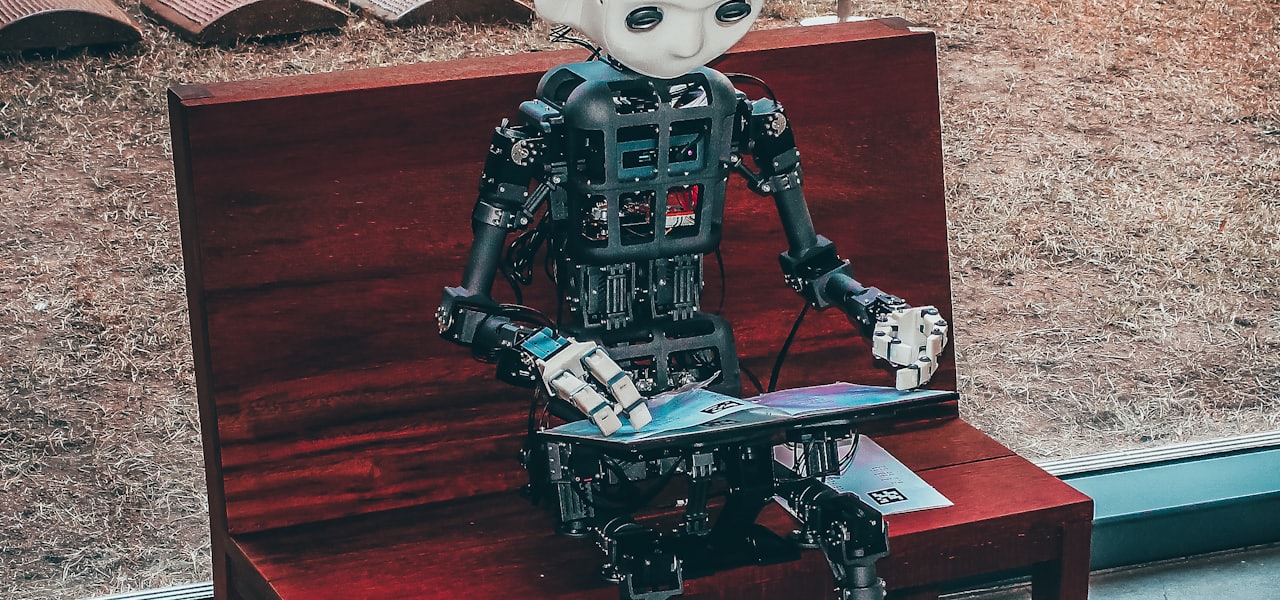
In the context of generative artificial intelligence, AI agents (also referred to as compound AI systems or agentic AI) are a class of intelligent agents that can pursue goals, use tools, and take actions with varying degrees of autonomy. In practice, they usually operate within human-defined objectives, constraints, and available tools. == Overview == AI agents possess several key attributes, including goal-directed behavior, natural language interfaces, the capacity to use external tools, and the ability to perform multi-step tasks. Their control flow is frequently driven by large language models (LLMs). Agent systems may also include memory components, planning logic, tool interfaces, and orchestration software for coordinating agent components. AI agents do not have a standard definition. NIST describes agentic AI as an emerging area requiring standards for secure operation, interoperability, and reliable interaction with external systems. A common application of AI agents is task automation: for example, booking travel plans based on a user's prompted request. Companies such as Google, Microsoft and Amazon Web Services have offered platforms for deploying pre-built AI agents. Several protocols have been proposed for standardizing inter-agent communication, with examples including the Model Context Protocol, Gibberlink, and many others. Some of these protocols are also used for connecting agents to external applications. In December 2025, Linux Foundation announced the formation of the Agentic AI Foundation (AAIF), with the goal of ensuring agentic AI evolves transparently and collaboratively. == History == AI agents have been traced back to research from the 1990s, with Harvard professor Milind Tambe noting that the definition of an AI agent was not clear at the time. Researcher Andrew Ng has been credited with spreading the term "agentic" to a wider audience in 2024. == Training and testing == Researchers have attempted to build world models and reinforcement learning environments to train or evaluate AI agents. For example, video games such as Minecraft and No Man's Sky as well as replicas of company websites, have also been used for training such agents. == Autonomous capabilities == The Financial Times compared the autonomy of AI agents to the SAE classification of self-driving cars, likening most applications to level 2 or level 3, with some achieving level 4 in highly specialized circumstances, and level 5 being theoretical. == Cognitive architecture == The following are some internal design options for reasoning within an agent: Retrieval-augmented generation ReAct (Reason + Act) pattern is an iterative process in which an AI agent alternates between reasoning and taking actions, receives observations from the environment or external tools, and integrates these observations into subsequent reasoning steps. Reflexion, which uses an LLM to create feedback on the agent's plan of action and stores that feedback in a memory cache. A tool/agent registry, for organizing software functions or other agents that the agent can use. One-shot model querying, which queries the model once to create the plan of action. === Reference architecture === Ken Huang proposed an AI agent reference architecture, which consists of seven interconnected layers, with each layer building on the functionality of the layers beneath it: Layer 1: Foundation models - provide the core AI engines to power agent capabilities. Layer 2: Data operations - manage the complex data infrastructure required for AI agent operations, including Vector database, data loaders, RAG. Layer 3: Agent frameworks - sophisticated software and tools that simplify the development and management of the AI agents. Layer 4: Deployment and infrastructure - provide the robust technical foundation for running AI agents. Layer 5: Evaluation and observability - focus on assessing the safety and performance of AI agents. Layer 6: Security and compliance - a crucial protective framework ensuring AI agents operate safely, securely, and conform to regulatory boundaries. At this layer security and compliance features embedded into all the AI agent stack layers are integrated together. Layer 7: Agent ecosystem - represents the AI agents' interface with real-world applications and users. == Orchestration patterns == To execute complex tasks, autonomous agents are often integrated with other agents or specialized tools. These configurations, known as orchestration patterns or workflows, include the following: Prompt chaining: A sequence where the output of one step serves as the input for the next. Routing: The classification of an input to direct it to a specialized downstream task or tool. Parallelization: The simultaneous execution of multiple tasks. Sequential processing: A fixed, linear progression of tasks through a predefined pipeline. Planner-critic: An iterative pattern where one agent generates a proposal and another evaluates it to provide feedback for refinement. == Multimodal AI agents == In addition to large language models (LLMs), vision-language models (VLMs) and multimodal foundation models can be used as the basis for agents. In September 2024, Allen Institute for AI released an open-source vision-language model. Nvidia released a framework for developers to use VLMs, LLMs and retrieval-augmented generation for building AI agents that can analyze images and videos, including video search and video summarization. Microsoft released a multimodal agent model – trained on images, video, software user interface interactions, and robotics data – that the company claimed can manipulate software and robots. == Applications == As of April 2025, per the Associated Press, there are few real-world applications of AI agents. As of June 2025, per Fortune, many companies are primarily experimenting with AI agents. The Information divided AI agents into seven archetypes: business-task agents, for acting within enterprise software; conversational agents, which act as chatbots for customer support; research agents, for querying and analyzing information (such as OpenAI Deep Research); analytics agents, for analyzing data to create reports; software developer or coding agents (such as Cursor); domain-specific agents, which include specific subject matter knowledge; and web browser agents (such as OpenAI Operator). By mid-2025, AI agents have been used in video game development, gambling (including sports betting), cryptocurrency wallets (including cryptocurrency trading and meme coins) and social media. In August 2025, New York Magazine described software development as the most definitive use case of AI agents. Likewise, by October 2025, noting a decline in expectations, The Information noted AI coding agents and customer support as the primary use cases by businesses. In November 2025, The Wall Street Journal reported that few companies that deployed AI agents have received a return on investment. === Applications in government === Several government bodies in the United States and United Kingdom have deployed or announced the deployment of agents, at the local and national level. The city of Kyle, Texas deployed an AI agent from Salesforce in March 2025 for 311 customer service. In November 2025, the Internal Revenue Service stated that it would use Agentforce, AI agents from Salesforce, for the Office of Chief Counsel, Taxpayer Advocate Services and the Office of Appeals. That same month, Staffordshire Police announced that they would trial Agentforce agents for handling non-emergency 101 calls in the United Kingdom starting in 2026. In December 2025, the Department of Neighborhoods in Detroit, Michigan, in partnership with a local business, deployed a pilot project in two Detroit districts for an AI agent to be used for customer service calls. In February 2025, Thomas Shedd, the director of the Technology Transformation Services, proposed using AI coding agents across the United States federal government. A recruiter for the Department of Government Efficiency proposed in April 2025 to use AI agents to automate the work of about 70,000 United States federal government employees, as part of a startup with funding from OpenAI and a partnership agreement with Palantir. This proposal was criticized by experts for its impracticality, if not impossibility, and the lack of corresponding widespread adoption by businesses. In December 2025, the Food and Drug Administration announced that it would offer "agentic AI capabilities" to its staff for "meeting management, pre-market reviews, review validation, post-market surveillance, inspections and compliance and administrative functions." That same month, the United States Department of Defense launched GenAI.mil, an internal platform for American military personnel to use generative AI-based applications based on Google Gemini, including "intelligent agentic workflows". Defense Secretary Pete Hegseth listed applications such as "[conducting] deep r
StyleGAN
The Style Generative Adversarial Network, or StyleGAN for short, is an extension to the GAN architecture introduced by Nvidia researchers in December 2018, and made source available in February 2019. StyleGAN depends on Nvidia's CUDA software, GPUs, and Google's TensorFlow, or Meta AI's PyTorch, which supersedes TensorFlow as the official implementation library in later StyleGAN versions. The second version of StyleGAN, called StyleGAN2, was published on February 5, 2020. It removes some of the characteristic artifacts and improves the image quality. Nvidia introduced StyleGAN3, described as an "alias-free" version, on June 23, 2021, and made source available on October 12, 2021. == History == A direct predecessor of the StyleGAN series is the Progressive GAN, published in 2017. In December 2018, Nvidia researchers distributed a preprint with accompanying software introducing StyleGAN, a GAN for producing an unlimited number of (often convincing) portraits of fake human faces. StyleGAN was able to run on Nvidia's commodity GPU processors. In February 2019, Uber engineer Phillip Wang used the software to create the website This Person Does Not Exist, which displayed a new face on each web page reload. Wang himself has expressed amazement, given that humans are evolved to specifically understand human faces, that nevertheless StyleGAN can competitively "pick apart all the relevant features (of human faces) and recompose them in a way that's coherent." In September 2019, a website called Generated Photos published 100,000 images as a collection of stock photos. The collection was made using a private dataset shot in a controlled environment with similar light and angles. Similarly, two faculty at the University of Washington's Information School used StyleGAN to create Which Face is Real?, which challenged visitors to differentiate between a fake and a real face side by side. The faculty stated the intention was to "educate the public" about the existence of this technology so they could be wary of it, "just like eventually most people were made aware that you can Photoshop an image". The second version of StyleGAN, called StyleGAN2, was published on February 5, 2020. It removes some of the characteristic artifacts and improves the image quality. In 2021, a third version was released, improving consistency between fine and coarse details in the generator. Dubbed "alias-free", this version was implemented with PyTorch. === Illicit use === In December 2019, Facebook took down a network of accounts with false identities, and mentioned that some of them had used profile pictures created with machine learning techniques. == Architecture == === Progressive GAN === Progressive GAN is a method for training GAN for large-scale image generation stably, by growing a GAN generator from small to large scale in a pyramidal fashion. Like SinGAN, it decomposes the generator as G = G 1 ∘ G 2 ∘ ⋯ ∘ G N {\displaystyle G=G_{1}\circ G_{2}\circ \cdots \circ G_{N}} , and the discriminator as D = D N ∘ D N − 1 ∘ ⋯ ∘ D 1 {\displaystyle D=D_{N}\circ D_{N-1}\circ \cdots \circ D_{1}} . During training, at first only G N , D N {\displaystyle G_{N},D_{N}} are used in a GAN game to generate 4x4 images. Then G N − 1 , D N − 1 {\displaystyle G_{N-1},D_{N-1}} are added to reach the second stage of GAN game, to generate 8x8 images, and so on, until we reach a GAN game to generate 1024x1024 images. To avoid discontinuity between stages of the GAN game, each new layer is "blended in" (Figure 2 of the paper). For example, this is how the second stage GAN game starts: Just before, the GAN game consists of the pair G N , D N {\displaystyle G_{N},D_{N}} generating and discriminating 4x4 images. Just after, the GAN game consists of the pair ( ( 1 − α ) + α ⋅ G N − 1 ) ∘ u ∘ G N , D N ∘ d ∘ ( ( 1 − α ) + α ⋅ D N − 1 ) {\displaystyle ((1-\alpha )+\alpha \cdot G_{N-1})\circ u\circ G_{N},D_{N}\circ d\circ ((1-\alpha )+\alpha \cdot D_{N-1})} generating and discriminating 8x8 images. Here, the functions u , d {\displaystyle u,d} are image up- and down-sampling functions, and α {\displaystyle \alpha } is a blend-in factor (much like an alpha in image composing) that smoothly glides from 0 to 1. === StyleGAN === StyleGAN is designed as a combination of Progressive GAN with neural style transfer. The key architectural choice of StyleGAN-1 is a progressive growth mechanism, similar to Progressive GAN. Each generated image starts as a constant 4 × 4 × 512 {\displaystyle 4\times 4\times 512} array, and repeatedly passed through style blocks. Each style block applies a "style latent vector" via affine transform ("adaptive instance normalization"), similar to how neural style transfer uses Gramian matrix. It then adds noise, and normalize (subtract the mean, then divide by the variance). At training time, usually only one style latent vector is used per image generated, but sometimes two ("mixing regularization") in order to encourage each style block to independently perform its stylization without expecting help from other style blocks (since they might receive an entirely different style latent vector). After training, multiple style latent vectors can be fed into each style block. Those fed to the lower layers control the large-scale styles, and those fed to the higher layers control the fine-detail styles. Style-mixing between two images x , x ′ {\displaystyle x,x'} can be performed as well. First, run a gradient descent to find z , z ′ {\displaystyle z,z'} such that G ( z ) ≈ x , G ( z ′ ) ≈ x ′ {\displaystyle G(z)\approx x,G(z')\approx x'} . This is called "projecting an image back to style latent space". Then, z {\displaystyle z} can be fed to the lower style blocks, and z ′ {\displaystyle z'} to the higher style blocks, to generate a composite image that has the large-scale style of x {\displaystyle x} , and the fine-detail style of x ′ {\displaystyle x'} . Multiple images can also be composed this way. === StyleGAN2 === StyleGAN2 improves upon StyleGAN in two ways. One, it applies the style latent vector to transform the convolution layer's weights instead, thus solving the "blob" problem. The "blob" problem roughly speaking is because using the style latent vector to normalize the generated image destroys useful information. Consequently, the generator learned to create a "distraction" by a large blob, which absorbs most of the effect of normalization (somewhat similar to using flares to distract a heat-seeking missile). Two, it uses residual connections, which helps it avoid the phenomenon where certain features are stuck at intervals of pixels. For example, the seam between two teeth may be stuck at pixels divisible by 32, because the generator learned to generate teeth during stage N-5, and consequently could only generate primitive teeth at that stage, before scaling up 5 times (thus intervals of 32). This was updated by the StyleGAN2-ADA ("ADA" stands for "adaptive"), which uses invertible data augmentation. It also tunes the amount of data augmentation applied by starting at zero, and gradually increasing it until an "overfitting heuristic" reaches a target level, thus the name "adaptive". === StyleGAN3 === StyleGAN3 improves upon StyleGAN2 by solving the "texture sticking" problem, which can be seen in the official videos. They analyzed the problem by the Nyquist–Shannon sampling theorem, and argued that the layers in the generator learned to exploit the high-frequency signal in the pixels they operate upon. To solve this, they proposed imposing strict lowpass filters between each generator's layers, so that the generator is forced to operate on the pixels in a way faithful to the continuous signals they represent, rather than operate on them as merely discrete signals. They further imposed rotational and translational invariance by using more signal filters. The resulting StyleGAN-3 is able to generate images that rotate and translate smoothly, and without texture sticking.
Open Sound Control
Open Sound Control (OSC) is a protocol for networking sound synthesizers, computers, and other multimedia devices for purposes such as musical performance or show control. OSC's advantages include interoperability, accuracy, flexibility and enhanced organization and documentation. Its disadvantages include higher bandwidth requirements, increased load on embedded processors, and lack of standardized messages/interoperability. The first specification was released in March 2002. == Motivation == OSC is a content format developed at CNMAT by Adrian Freed and Matt Wright comparable to XML, WDDX, or JSON. It was originally intended for sharing music performance data (gestures, parameters and note sequences) between musical instruments (especially electronic musical instruments such as synthesizers), computers, and other multimedia devices. OSC is sometimes used as an alternative to the 1983 MIDI standard, when higher resolution and a richer parameter space is desired. OSC messages are transported across the internet and within local subnets using UDP/IP and Ethernet. OSC messages between gestural controllers are usually transmitted over serial endpoints of USB wrapped in the SLIP protocol. == Features == OSC's main features, compared to MIDI, include: Open-ended, dynamic, URI-style symbolic naming scheme Symbolic and high-resolution numeric data Pattern matching language to specify multiple recipients of a single message High resolution time tags "Bundles" of messages whose effects must occur simultaneously == Applications == There are dozens of OSC applications, including real-time sound and media processing environments, web interactivity tools, software synthesizers, programming languages and hardware devices. OSC has achieved wide use in fields including musical expression, robotics, video performance interfaces, distributed music systems and inter-process communication. The TUIO community standard for tangible interfaces such as multitouch is built on top of OSC. Similarly the GDIF system for representing gestures integrates OSC. OSC is used extensively in experimental musical controllers, and has been built into several open source and commercial products. The Open Sound World (OSW) music programming language is designed around OSC messaging. OSC is the heart of the DSSI plugin API, an evolution of the LADSPA API, in order to make the eventual GUI interact with the core of the plugin via messaging the plugin host. LADSPA and DSSI are APIs dedicated to audio effects and synthesizers. In 2007, a standardized namespace within OSC called SYN, for communication between controllers, synthesizers and hosts, was proposed. == Design == OSC messages consist of an address pattern (such as /oscillator/4/frequency), a type tag string (such as ,fi for a float32 argument followed by an int32 argument), and the arguments themselves (which may include a time tag). Address patterns form a hierarchical name space, reminiscent of a Unix filesystem path, or a URL, and refer to "Methods" inside the server, which are invoked with the attached arguments. Type tag strings are a compact string representation of the argument types. Arguments are represented in binary form with four-byte alignment. The core types supported are 32-bit two's complement signed integers 32-bit IEEE floating point numbers Null-terminated arrays of eight-bit encoded data (C-style strings) arbitrary sized blob (e.g. audio data, or a video frame) An example message is included in the spec (with null padding bytes represented by ␀): /oscillator/4/frequency␀,f␀␀, Followed by the 4-byte float32 representation of 440.0: 0x43dc0000. Messages may be combined into bundles, which themselves may be combined into bundles, etc. Each bundle contains a timestamp, which determines whether the server should respond immediately or at some point in the future. Applications commonly employ extensions to this core set. More recently some of these extensions such as a compact Boolean type were integrated into the required core types of OSC 1.1. The advantages of OSC over MIDI are primarily internet connectivity; data type resolution; and the comparative ease of specifying a symbolic path, as opposed to specifying all connections as seven-bit numbers with seven-bit or fourteen-bit data types. This human-readability has the disadvantage of being inefficient to transmit and more difficult to parse by embedded firmware, however. The spec does not define any particular OSC Methods or OSC Containers. All messages are implementation-defined and vary from server to server.
SD-WAN
A Software-Defined Wide Area Network (SD-WAN) is a wide area network that uses software-defined networking technology, such as communicating over the Internet using overlay tunnels which are encrypted when destined for internal organization locations. If standard tunnel setup and configuration messages are supported by all of the network hardware vendors, SD-WAN simplifies the management and operation of a WAN by decoupling the networking hardware from its control mechanism. This concept is similar to how software-defined networking implements virtualization technology to improve data center management and operation. In practice, proprietary protocols are used to set up and manage an SD-WAN, meaning there is no decoupling of the hardware and its control mechanism. A key application of SD-WAN is to allow companies to build higher-performance WANs using lower-cost and commercially available Internet access, enabling businesses to partially or wholly replace more expensive private WANs connection technologies such as MPLS. When SD-WAN traffic is carried over the Internet, there are no end-to-end performance guarantees. Carrier MPLS VPN WAN services are not carried as Internet traffic, but rather over carefully controlled carrier capacity, and do come with an end-to-end performance guarantee. == History == WANs were very important for the development of networking in general and for a long time one of the most important applications of networks both for military and enterprise applications. The ability to communicate data over long distances was one of the main driving factors for the development of data communications, as it made it possible to overcome the distance limitations, as well as shortening the time necessary to exchange messages with other parties. Legacy WANs allowed communication over circuits connecting two or more endpoints. Earlier networking supported point-to-point communication over a slow speed circuit, usually between two fixed locations. As networking progressed, WAN circuits became faster and more flexible. Innovations like circuit and packet switching (in the form of X.25, ATM and later Internet Protocol or Multiprotocol Label Switching) allowed communication to become more dynamic, supporting ever-growing networks. The need for strict control, security and quality of service (QOS) meant that multinational corporations were very conservative in leasing and operating their WANs. National regulations restricted the companies that could provide local service in each country, and complex arrangements were necessary to establish truly global networks. All that changed with the growth of the Internet, which permitted entities around the world to connect to each other. However, over the first years, the uncontrolled nature of the Internet was not considered adequate or safe for private corporate use. Independent of safety concerns, connectivity to the Internet became a necessity to the point where every branch required Internet access. At first, due to safety concerns, private communications were still done via WAN, and communication with other entities (including customers and partners) moved to the Internet. As the Internet grew in reach and maturity, companies started to evaluate how to leverage it for private corporate communications. During the early 2000s, application delivery over the WAN became an important topic of research and commercial innovation. Over the next decade, increasing computing power made it possible to create software-based appliances that were able to analyze traffic and make informed decisions without delays, making it possible to create large-scale overlay networks over the public Internet that could replicate all the functionality of legacy WANs, at a fraction of the cost. SD-WAN combines several networking aspects to create full-fledged private networks, with the ability to dynamically share network bandwidth across the connection points. Additional enhancements include central controllers, zero-touch provisioning, integrated analytics and on-demand circuit provisioning, with some network intelligence based in the cloud, allowing centralized policy management and security. Networking publications started using the term SD-WAN to describe this new networking trend as early as 2014. With the rapid shift to remote work as a result of lockdowns and stay at home orders during the COVID-19 pandemic, SD-WAN grew in popularity as a way of connecting remote workers. == Overview == WANs allow companies to extend their computer networks over large distances, connecting remote branch offices to data centers and to each other, and delivering applications and services required to perform business functions. Due to the physical constraints imposed by the propagation time over large distances, and the need to integrate multiple service providers to cover global geographies (often crossing nation boundaries), WANs face important operational challenges, including network congestion, packet delay variation, packet loss, and even service outages. Modern applications such as VoIP calling, videoconferencing, streaming media, and virtualized applications and desktops require low latency. Bandwidth requirements are also increasing, especially for applications featuring high-definition video. It can be expensive and difficult to expand WAN capability, with corresponding difficulties related to network management and troubleshooting. SD-WAN products are designed to address these network problems. By enhancing or even replacing traditional branch routers with virtualization appliances that can control application-level policies and offer a network overlay, less expensive consumer-grade Internet links can act more like a dedicated circuit. This simplifies the setup process for branch personnel. SD-WAN products can be physical appliances or software based only. === Components === The MEF Forum has defined an SD-WAN architecture consisting of an SD-WAN edge, SD-WAN gateway, SD-WAN controller and SD-WAN orchestrator. ==== SD-WAN edge ==== The SD-WAN edge is a physical or virtual network function that is placed at an organization's branch/regional/central office site, data center, and in public or private cloud platforms. MEF Forum has published the first SD-WAN service standard, MEF 70 which defines the fundamental characteristics of an SD-WAN service plus service requirements and attributes. ==== SD-WAN gateway ==== SD-WAN gateways provide access to the SD-WAN service in order to shorten the distance to cloud-based services or the user, and reduce service interruptions. A distributed network of gateways may be included in an SD-WAN service by the vendor or setup and maintained by the organization using the service. By sitting outside the headquarters in the cloud, the gateway also reduces headquarters traffic. ==== SD-WAN orchestrator ==== The SD-WAN orchestrator is a cloud hosted or on-premises web management tool that allows configuration, provisioning and other functions when operating an SD-WAN. It simplifies application traffic management by allowing central implementation of an organization's business policies. ==== SD-WAN controller ==== The SD-WAN controller functionality, which can be placed in the orchestrator or in an SD-WAN gateway, is used to make forwarding decisions for application flows. Application flows are IP packets that have been classified to determine their user application or grouping of applications to which they are associated. The grouping of application flows based on a common type, e.g., conferencing applications, is referred to as an Application Flow Group in MEF 70. Per MEF 70, the SD-WAN Edge classifies incoming IP packets at the SD-WAN UNI (SD-WAN user network interface), determines, via OSI Layer 2 through Layer 7 classification, which application flow the IP packets belong to, and then applies the policies to block the application flow or allow the application flows to be forwarded based on the availability of a route to the destination SD-WAN UNI on a remote SD-WAN Edge. This helps ensure that application performance meets service level agreements (SLAs). == Required characteristics == The Gartner research firm has defined an SD-WAN as having four required characteristics: The ability to support multiple connection types, such as MPLS, last mile fiber optic network or through high speed cellular networks e.g. 4G LTE and 5G wireless technologies The ability to do dynamic path selection, for load sharing and resiliency purposes A simple interface that is easy to configure and manage The ability to support VPNs, and third party services such as WAN optimization controllers, firewalls and web gateways == Features == Features of SD-WANs include resilience, quality of service (QoS), security, and performance, with flexible deployment options; simplified administration and troubleshooting; and online traffic engineering. === Resilience === A resilient SD-WAN reduces network downtime. To
Visopsys
Visopsys (Visual Operating System), is an operating system, written by Andy McLaughlin. Development of the operating system began in 1997. The operating system is licensed under the GNU GPL, with the headers and libraries under the less restrictive LGPL license. It runs on the 32-bit IA-32 architecture. It features a multitasking kernel, supports asynchronous I/O and the FAT line of file systems. It requires a Pentium processor. == History == The development of Visopsys began in 1997, being written by Andy McLaughlin. The first public release of the Operating System was on 2 March 2001, with version 0.1. In this release, Visopsys was a 32 bit operating system, supporting preemptive multitasking and virtual memory. == System overview == Visopsys uses a monolithic kernel, written in the C programming language, with elements of assembly language for certain interactions with the hardware. The operating system supports a graphical user interface, with a small C library.
Quantum artificial life
Quantum artificial life is the application of quantum algorithms with the ability to simulate biological behavior. Quantum computers offer many potential improvements to processes performed on classical computers, including machine learning and artificial intelligence. Artificial intelligence applications are often inspired by the idea of mimicking human brains through closely related biomimicry. This has been implemented to a certain extent on classical computers (using neural networks), but quantum computers offer many advantages in the simulation of artificial life. Artificial life and artificial intelligence are extremely similar, with minor differences; the goal of studying artificial life is to understand living beings better, while the goal of artificial intelligence is to create intelligent beings. In 2016, Alvarez-Rodriguez et al. developed a proposal for a quantum artificial life algorithm with the ability to simulate life and Darwinian evolution. In 2018, the same research team led by Alvarez-Rodriguez performed the proposed algorithm on the IBM ibmqx4 quantum computer, and received optimistic results. The results accurately simulated a system with the ability to undergo self-replication at the quantum scale. == Artificial life on quantum computers == The growing advancement of quantum computers has led researchers to develop quantum algorithms for simulating life processes. Researchers have designed a quantum algorithm that can accurately simulate Darwinian Evolution. Since the complete simulation of artificial life on quantum computers has only been actualized by one group, this section shall focus on the implementation by Alvarez-Rodriguez, Sanz, Lomata, and Solano on an IBM quantum computer. Individuals were realized as two qubits, one representing the genotype of the individual and the other representing the phenotype. The genotype is copied to transmit genetic information through generations, and the phenotype is dependent on the genetic information as well as the individual's interactions with their environment. In order to set up the system, the state of the genotype is instantiated by some rotation of an ancillary state ( | 0 ⟩ ⟨ 0 | {\displaystyle |0\rangle \langle 0|} ). The environment is a two-dimensional spatial grid occupied by individuals and ancillary states. The environment is divided into cells that are able to possess one or more individuals. Individuals move throughout the grid and occupy cells randomly; when two or more individuals occupy the same cell they interact with each other. === Self replication === The ability to self-replicate is critical for simulating life. Self-replication occurs when the genotype of an individual interacts with an ancillary state, creating a genotype for a new individual; this genotype interacts with a different ancillary state in order to create the phenotype. During this interaction, one would like to copy some information about the initial state into the ancillary state, but by the no cloning theorem, it is impossible to copy an arbitrary unknown quantum state. However, physicists have derived different methods for quantum cloning which does not require the exact copying of an unknown state. The method that has been implemented by Alvarez-Rodriguez et al. is one that involves the cloning of the expectation value of some observable. For a unitary U {\displaystyle U} which copies the expectation value of some set of observables X {\displaystyle {\mathsf {X}}} of state ρ {\displaystyle \rho } into a blank state ρ e {\displaystyle \rho _{e}} , the cloning machine is defined by any ( U , ρ e , X ) {\displaystyle (U,\rho _{e},{\mathsf {X}})} that fulfill the following: ∀ ρ ∀ X ∈ X {\displaystyle \forall \rho \forall X\in {\mathsf {X}}} X ¯ = X 1 ¯ = X 2 ¯ {\displaystyle {\bar {X}}={\bar {X_{1}}}={\bar {X_{2}}}} Where X ¯ {\displaystyle {\bar {X}}} is the mean value of the observable in ρ {\displaystyle \rho } before cloning, X 1 ¯ {\displaystyle {\bar {X_{1}}}} is the mean value of the observable in ρ {\displaystyle \rho } after cloning, and X 2 ¯ {\displaystyle {\bar {X_{2}}}} is the mean value of the observable in ρ e {\displaystyle \rho _{e}} after cloning. Note that the cloning machine has no dependence on ρ {\displaystyle \rho } because we want to be able to clone the expectation of the observables for any initial state. It is important to note that cloning the mean value of the observable transmits more information than is allowed classically. The calculation of the mean value is defined naturally as: X ¯ = T r [ ρ X ] {\displaystyle {\bar {X}}=Tr[\rho X]} , X 1 ¯ = T r [ R X ⊗ I ] {\displaystyle {\bar {X_{1}}}=Tr[RX\otimes I]} , X 2 ¯ = T r [ R I ⊗ X ] {\displaystyle {\bar {X_{2}}}=Tr[RI\otimes X]} where R = U ρ ⊗ ρ e U † {\displaystyle R=U\rho \otimes \rho _{e}U^{\dagger }} The simplest cloning machine clones the expectation value of σ z {\displaystyle \sigma _{z}} in arbitrary state ρ = | ψ ⟩ ⟨ ψ | {\displaystyle \rho =|\psi \rangle \langle \psi |} to ρ e = | 0 ⟩ ⟨ 0 | {\displaystyle \rho _{e}=|0\rangle \langle 0|} using U = C N O T {\displaystyle U=CNOT} . This is the cloning machine implemented for self-replication by Alvarez-Rodriguez et al. The self-replication process clearly only requires interactions between two qubits, and therefore this cloning machine is the only one necessary for self replication. === Interactions === Interactions occur between individuals when the two take up the same space on the environmental grid. The presence of interactions between individuals provides an advantage for shorter-lifespan individuals. When two individuals interact, exchanges of information between the two phenotypes may or may not occur based on their existing values. When both individual's control qubits (genotypes) are alike, no information will be exchanged. When the control qubits differ, the target qubits (phenotype) will be exchanged between the two individuals. This procedure produces a constantly changing predator-prey dynamic in the simulation. Therefore, long-living qubits, with a larger genetic makeup in the simulation, are at a disadvantage. Since information is only exchanged when interacting with an individual of different genetic makeup, the short-lived population has the advantage. === Mutation === Mutations exist in the artificial world with limited probability, equivalent to their occurrence in the real world. There are two ways in which the individual can mutate: through random single qubit rotations and by errors in the self-replication process. There are two different operators that act on the individual and cause mutations. The M operation causes a spontaneous mutation within the individual by rotating a single qubit by parameter θ. The parameter θ is random for each mutation, which creates biodiversity within the artificial environment. The M operation is a unitary matrix which can be described as: M = ( cos ( θ ) s i n ( θ ) s i n ( θ ) − c o s ( θ ) ) {\displaystyle M={\begin{pmatrix}\cos(\theta )&sin(\theta )\\sin(\theta )&-cos(\theta )\end{pmatrix}}} The other possible way for mutations to occur is due to errors in the replication process. Due to the no-cloning theorem, it is impossible to produce perfect copies of systems that are originally in unknown quantum states. However, quantum cloning machines make it possible to create imperfect copies of quantum states, in other words, the process introduces some degree of error. The error that exists in current quantum cloning machines is the root cause for the second kind of mutations in the artificial life experiment. The imperfect cloning operation can be seen as: U M ( θ ) = I 4 + 1 2 ( 0 0 0 1 ) ⊗ ( − 1 1 1 − 1 ) ( c o s θ + i s i n θ + 1 ) {\displaystyle U_{M}(\theta )=\mathrm {I} _{4}+{\frac {1}{2}}{\begin{pmatrix}0&0\\0&1\end{pmatrix}}\otimes {\begin{pmatrix}-1&1\\1&-1\end{pmatrix}}(cos\theta +isin\theta +1)} The two kinds of mutations affect the individual differently. While the spontaneous M operation does not affect the phenotype of the individual, the self-replicating error mutation, UM, alters both the genotype of the individual, and its associated lifetime. The presence of mutations in the quantum artificial life experiment is critical for providing randomness and biodiversity. The inclusion of mutations helps to increase the accuracy of the quantum algorithm. === Death === At the instant the individual is created (when the genotype is copied into the phenotype), the phenotype interacts with the environment. As time evolves, the interaction of the individual with the environment simulates aging which eventually leads to the death of the individual. The death of an individual occurs when the expectation value of σ z {\displaystyle \sigma _{z}} is within some ϵ {\displaystyle \epsilon } of 1 in the phenotype, or, equivalently, when ρ p = | 0 ⟩ ⟨ 0 | {\displaystyle \rho _{p}=|0\rangle \langle 0|} The Lindbladian describes the interaction of the individual with the environment: ρ
Elonis v. United States
Elonis v. United States, 575 U.S. 723 (2015), was a United States Supreme Court case concerning whether conviction of threatening another person over interstate lines (under 18 U.S.C. § 875(c)) requires proof of subjective intent to threaten or whether it is enough to show that a "reasonable person" would regard the statement as threatening. In controversy were the purported threats of violent rap lyrics written by Anthony Douglas Elonis and posted to Facebook under a pseudonym. The ACLU filed an amicus brief in support of the petitioner. It was the first time the Court has heard a case considering true threats and the limits of speech on social media. == Background == In May 2010, Elonis was in the process of divorce and made a number of public Facebook posts. Prior to his postings, he had lost his job at an amusement park. He "posted the script of a sketch" by The Whitest Kids U' Know, which originally referenced saying "I want to kill the President of the United States" and replaced the president with his wife: Elonis ended the post with this statement: "Art is about pushing limits. I'm willing to go to jail for my constitutional rights. Are you?" A week later, Elonis posted about local law enforcement and a kindergarten class, which caught the attention of the Federal Bureau of Investigation. Then, he wrote a post on Facebook about one of the agents who visited him: He concluded: == Arrest and Conviction == These actions led to Elonis's arrest on December 8, 2010. He was indicted by a grand jury on five counts of threats to his estranged ex-wife, park employees and visitors, local law enforcement, an FBI agent, and a kindergarten class that had been relayed through interstate communication. At the district court, Elonis moved to dismiss the indictment for failing to allege that he had intended to threaten anyone, claiming his Facebook post was not were not intended as a threat. He argued that, as an aspiring rap artist, his posts were intended to be a form of artistic expression to help him cope with his recent loses. According to him, he did not mean anything said in his posts in a literal sense. His motion was denied. He requested a jury instruction that "the government must prove that he intended to communicate a true threat", which was also denied. He was convicted on the last four of the five counts, and was sentenced to 44 months in prison and three years on supervised release. He appealed unsuccessfully to the Third Circuit, renewing his challenge to the jury instructions. He then appealed to the U.S. Supreme Court based on lack of any attempt to show intent to threaten and on First Amendment rights. == Decision == On June 1, 2015, the U.S. Supreme Court reversed Elonis's conviction in an 8–1 decision. Chief Justice John Roberts wrote for a seven-justice majority, Samuel Alito authored an opinion concurring in part and dissenting in part, and Clarence Thomas authored a dissenting opinion. The finding of the circuit court was reversed and the matter remanded. === Majority opinion === The majority opinion, written by Roberts, did not rule on First Amendment matters or on the question of whether recklessness was sufficient mens rea to show intent. It ruled that mens rea was required to prove the commission of a crime under §875(c). Importantly, the mens rea issue had been preserved for review, since Elonis had raised that objection at every stage of the previous proceedings. The government contended that the presence of the words "intent to extort" in §875(b) and §875(d) implied that the absence in §875(c) was constructive. The court disagreed, holding that the absence of the language in §875(c) was because the section was intended to have a broader scope than threats relating to extortion. The opinion drew on many Supreme Court cases holding that in criminal law, mens rea was required though it had not been mentioned explicitly in statute. Consequently, the Supreme Court ruled in favor of Elonis. === Alito's concurrence === Justice Samuel Alito, concurring in part and dissenting in part, opined that while agreeing that mens rea was required and specifically that showing negligence was not sufficient, the court should have ruled on the question of recklessness. He further opined that recklessness was sufficient to show a crime under that provision on the basis that going further would amount to amending the statute, rather than interpreting it. Since Elonis explicitly argued that recklessness was not sufficient, Alito said: I would therefore remand for the Third Circuit to determine if Elonis’s failure (indeed, refusal) to argue for recklessness prevents reversal of his conviction. The Third Circuit should also have the opportunity to consider whether the conviction could be upheld on harmless error grounds. Alito also addressed the First Amendment question, elided by the majority opinion. He held that "lyrics in songs that are performed for an audience or sold in recorded form are unlikely to be interpreted as a real threat to a real person. ... Statements on social media that are pointedly directed at their victims, by contrast, are much more likely to be taken seriously." === Thomas's dissent === Justice Clarence Thomas, dissenting, wrote against discarding the "general intent" standard without replacing it with a clearer standard. Thomas argued that "there is no historical practice requiring more than general intent when a statute regulates speech." Thomas cited Rosen v. United States, arguing that general intent was sufficient in this case. However, the majority opinion offers refutation in that Rosen turned on ignorance of the law: knowledge as to whether material was legally obscene, not on whether it was intended to be obscene. Thomas also supported the government's claim that the presence of "intent to extort" language in the adjacent §875(b) and did not address the majority's reasoning on that language. Thomas used precedent, notably from the states and 18th-century England based on other but similar and, arguably, influencing legislation to support his "general intent" claim. Thomas also drew a parallel with general intent in tort. While he sought to address the First Amendment issues, he never strayed far from "general intent". == Aftermath == On remand, the Third Circuit reaffirmed the conviction "concluding beyond a reasonable doubt that Elonis would have been convicted if the jury had been properly instructed" and therefore was harmless error. In 2022, Elonis was once again arrested and indicted on three counts of cyberstalking involving three people. It was discovered that between 2018 and 2021, Elonis had sent numerous threatening messages over email, text, voice mail, and social media platforms like Twitter to a former prosecutor of the Eastern District of Pennsylvania, his ex-girlfriend, and ex-wife. On August 5, after a five-day trial, Elonis was found guilty on all three counts, and on March 23, 2023, he was sentenced by U.S. District Court Judge Edward G. Smith of Easton, Pennsylvania to twelve years and seven months in prison.